
VoiceInk Review (2026): What $29 Buys, Checked Against the Repository
VoiceInk is a dictation app for Apple Silicon Macs that runs the speech model on your own machine and charges $29 once instead of $144 a year. That combination is rare enough to explain most of its popularity, and having read its repository, its release history and its issue tracker, I think the popularity is deserved.
Then there is the part nobody writing about this app will tell you, because the "VoiceInk review" pages ranking today are written either by companies selling a competing dictation app or by directories that never opened the code. VoiceInk is one person. Pull requests are not accepted. The free "just compile it yourself" route has an open bug where the free build updates itself into the paid one and then asks for a licence. And on macOS 26 there is a hotkey failure that has been open since May.
None of that stops me recommending it. All of it changes what you should do in your first week. Every price and number here was read on 27 August 2026 from the vendor's own pages and from the project's GitHub repository, both linked so you can check them.
Buy it if your audio genuinely cannot go to someone else's server, or you are tired of renting software, and you are on an Apple Silicon Mac running macOS 14.4 or later. At $29 VoiceInk pays for itself against a Wispr Flow annual plan in under three months and then costs nothing, forever, on a machine with no internet connection required.
Skip it if you are on an Intel Mac (it will not run at all), if you also work on Windows or Linux, or if you want a support desk rather than an issue tracker. Those cases have better answers, and they are in "Who should not buy it" below.
Test these two things first, while the 14-day money-back guarantee is live: that your global shortcut fires reliably, and that battery drain in the background is acceptable on your machine. Both are live complaints in the project's own tracker, and both are easy to check in ten minutes.
VoiceInk at a glance
| What it is | Local voice-to-text for macOS that types into whatever app you are in |
|---|---|
| Price | $29 one Mac, $49 two Macs, $69 three Macs, one time, lifetime updates |
| Trial and refund | Free trial (length not published), 14-day money-back guarantee |
| Requirements | Apple Silicon only, macOS 14.4 or later, 8 GB RAM recommended |
| Where audio is processed | On your Mac, by default, with no account needed |
| Transcription models | Whisper via whisper.cpp, NVIDIA Parakeet via FluidAudio, SenseVoice Small, Apple's own recogniser, plus optional cloud providers with your key |
| Languages | No count published by the vendor; depends on the model you pick |
| Licence | GPL-3.0 per the README, buildable from source |
| Who makes it | Prakash Joshi, working solo |
| Current version | 2.13, released 27 August 2026 |
| Also on | iPhone, free, and noticeably behind the Mac app |
| Install | Download, or brew install --cask voiceink |
What you actually get for $29
You press a shortcut, you talk, you release, and text lands where your cursor was. The speech never leaves your Mac unless you choose otherwise. That is the core, and it has been solid for a year.
The version most reviews describe is not the version you will download. VoiceInk 2.0 shipped on 16 July 2026 and reorganised the app around Modes. A Mode, in the vendor's own words, "tells VoiceInk how to behave for a dictation session", and it can fire automatically based on which app you are in, which website you have open, or a spoken trigger word. Each Mode carries its own model, language, AI cleanup prompt, context settings and output behaviour. In practice that means your terminal, your email client and your Slack window each get a different set of rules without you touching anything.
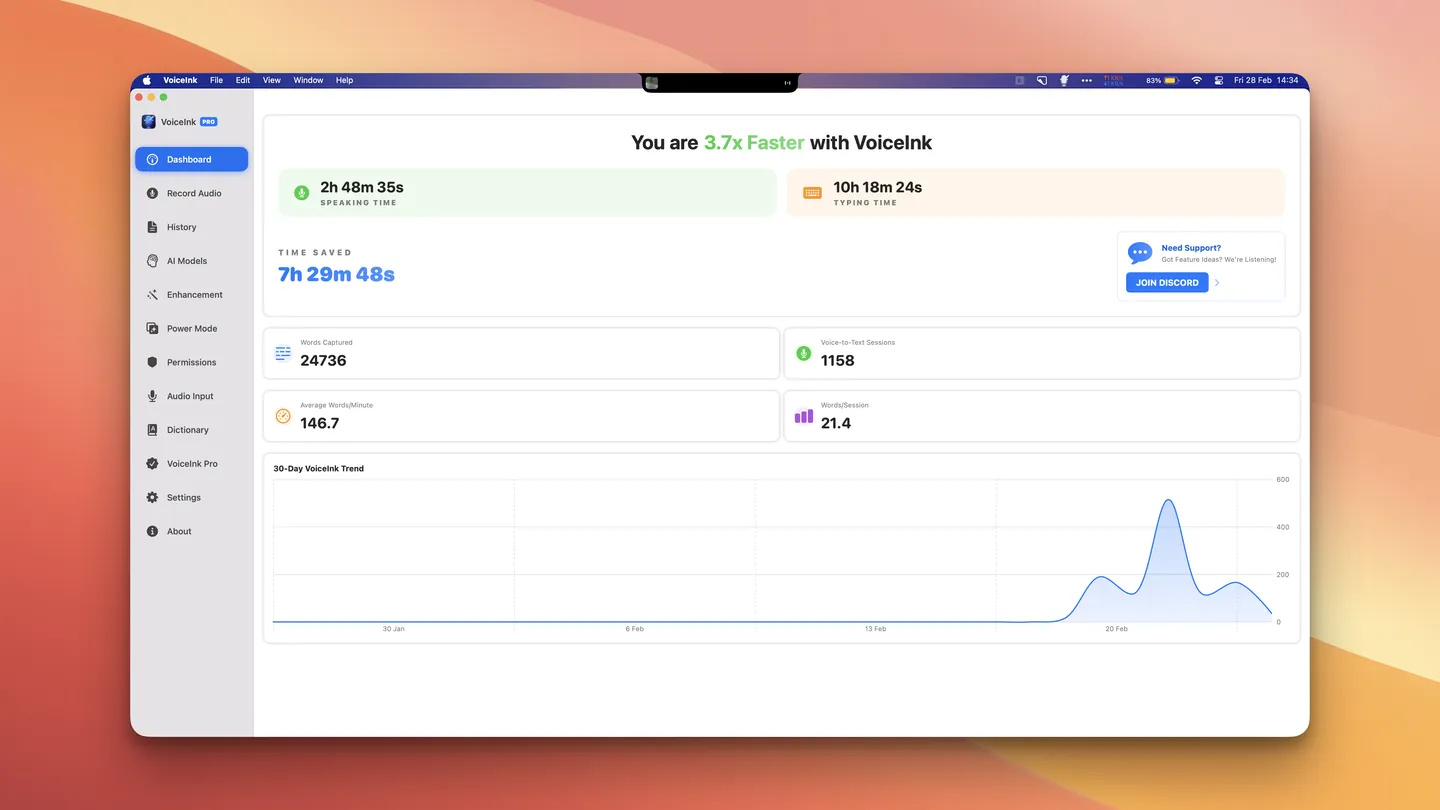
The same release added an Assistant mode for conversational follow-ups, plus German and Simplified Chinese interface localisations. Two releases later, on 12 August, the changelog line reads: "Added VoiceInk Refine for private, on-device transcription enhancement." That matters, because the standard criticism of local dictation apps, including the one in our own Mac roundup, is that they transcribe faithfully but do not tidy your rambling the way a cloud model does. Refine appears to be the answer to it. I will not tell you it works well, because there is no documentation for it anywhere on the vendor's site yet and nobody has written it up. Try it and judge.
There is also a personal dictionary for names and jargon, a searchable history, and a set of AI providers you can plug your own key into if you want a cloud model for cleanup. Recent releases added Gemini 3.5 Transcribe, an experimental Cohere model, and SenseVoice Small for local multilingual work.
What "open source" means for this particular project
Three things, and they are not the three things people assume.
You can read and compile it. The code is on GitHub, the README declares GPL-3.0, and BUILDING.md walks you through make local with Xcode. That is a real audit path, which is worth something for an app holding a microphone permission. Small wrinkle for the pedantic: the repository's LICENSE file contains only the GPL header and preamble with a link to the full text, so GitHub itself cannot classify it and shows the licence as "Other".
You cannot contribute. The README is blunt: "This project is not accepting pull requests at this time. You're welcome to fork and modify VoiceInk for your own use." Bug reports and feature requests, yes. Code, no. So the open licence gives you an escape hatch, not a community that fixes things.
Free is not quite free. Compiling it yourself costs $0 and loses you iCloud dictionary sync and automatic updates, which BUILDING.md states plainly. What it does not state, and what issue #829 has documented since 17 July 2026, is that local builds do check for updates anyway, replace themselves with the signed release build, and then ask for a licence key. The reporter traced it to the updater being started unconditionally with a live feed. It is still open. If your plan was to run the free build indefinitely, know that the plan currently has a hole in it.
Is the project alive? Yes, aggressively
This is the question I would want answered before paying for lifetime updates from a single developer, and it is the one no other review touches. Here is what the repository said on 27 August 2026.
| Signal | Value |
|---|---|
| Stars | 6,126 |
| Forks | 877 |
| Created | 20 October 2024 |
| Last 100 commits span | 26 July to 27 August 2026 |
| Of those 100 commits, by the maintainer | 96 |
| Releases since mid-July | 2.0, 2.1, 2.11, 2.13 |
| Downloads of the 2.11 build alone | over 18,000 |
| Open issues | 93 |
| Closed issues | 516 |
A hundred commits in a month and four releases in six weeks is not a hobby pace. Neither is 516 closed issues. Two of those numbers deserve a second look, though.
Ninety-six commits out of a hundred came from one account. This project has a bus factor of one, and combined with the closed pull request policy that is the honest risk you take on. The GPL licence and 877 forks are the mitigation, not a guarantee.
And the field has not been paying attention. A widely linked competitor review updated on 1 August 2026 still credits VoiceInk with "4,300+ stars, 570+ forks", numbers that are roughly 40 percent low. Same review, no mention of 2.0. That gap between what the project is doing and what the internet says it is doing is the whole reason this page exists.
Privacy, stated precisely
The vendor's claim is: "VoiceInk processes all voice transcription locally on your device. Your voice data never leaves your Mac." Cloud enhancement is described as "entirely optional", and when you switch it on, "only transcribed text (not your voice) is processed".
The privacy policy, last updated 20 April 2026, is more specific and worth reading, because it is short and it says useful things. Transcriptions live in a local SwiftData database. API keys go in the macOS Keychain. "VoiceInk does not collect or transmit any personal data by default." And a detail people miss: your transcriptions and any saved audio are "kept indefinitely by default" on your own disk until you delete them, with optional automatic cleanup after seven days that you have to turn on.
Two honest qualifications. First, issue #537, open since 16 February 2026, argues that the privacy policy does not fully document the data sent to external services. Second, "local" stops being true the moment you enable a cloud model or a cloud cleanup provider with your own key, which is exactly the configuration many people end up in. The architecture protects you by default; your settings can undo that.
What VoiceInk does not have is any compliance paperwork. No SOC 2, no ISO 27001, no HIPAA BAA. For a solo project that is unsurprising, and for a tool that never sends audio anywhere it is arguably beside the point, but if your employer's procurement process asks for a certificate, this app has none to give.
The money, with the arithmetic shown
Against Wispr Flow, the subscription most people are comparing it with, at $15 a month or $144 a year on the annual plan:
| VoiceInk Solo | Wispr Flow Pro annual | |
|---|---|---|
| Year 1 | $29 | $144 |
| Year 2 | $29 | $288 |
| Year 3 | $29 | $432 |
Break-even lands at about 2.4 months. After that the subscription simply keeps charging and VoiceInk does not.
One caveat that flatters the subscription: Wispr Flow is licensed per person and follows you across your machines, while VoiceInk charges per Mac. If you have a work laptop and a home desktop, the fair comparison is the $49 two-Mac licence, and break-even moves to about four months. Still not a close race.
Now the correction I promised. VoiceInk used to cost $25, and a large part of the web still says so. Wispr Flow's own comparison page, published January 2026, calls it "$25 one-time". So does at least one directory listing, and so does a competitor's dedicated VoiceInk pricing page quoting "$25, $39, $49". Even one of VoiceInk's own marketing pages, updated on 11 August 2026, still says "$25 to $49". The checkout page on 27 August 2026 says $29, $49 and $69. If you saw a lower number somewhere, that number is stale rather than a discount you are missing.
Flaws but not dealbreakers
The macOS 26 hotkey problem. Issue #735 was opened on 21 May 2026: global shortcut dead, push to talk dead, toggle dead, all permissions granted, nothing in the logs. Eighteen comments later it is still open. The workarounds people found in the thread are instructive about the shape of the bug rather than the app: fully removing and re-granting the Privacy and Security permissions, checking whether another app has switched on Secure Keyboard Entry, and looking for conflicts with Karabiner Elements. It does not hit everyone. If it hits you, you are debugging it with strangers on GitHub, so find out inside the refund window.
Battery and idle behaviour. Open reports include high background CPU with battery drain (April 2026), a local model that goes sluggish after the Mac sits idle because it gets paged out of memory (March 2026), and roughly a second of audio lost between the trigger sound and the recorder actually capturing (March 2026). All are open, all are the sort of thing that depends on your machine.
It is not the most polished thing in the category. A competitor's review scored it 7 out of 10 largely on interface refinement, which is self-interested but not wrong. And on Hacker News in February 2026 one user wrote that he "used to use VoiceInk" but moved to Spokenly, finding it "easier to use for post-processing the output, and more stable overall". Another, in December 2025, "needed some patches to get it to compile but Claude figured it out". These are enthusiastic-technical-user reports, not complaints from people who expected consumer software.
Nobody publishes a language count, including the vendor. Reviews claiming "100+ languages" are extrapolating from Whisper. What is actually true is that coverage depends on the model you select: NVIDIA's Parakeet v3 model card names exactly 25 European languages, while the Whisper models are multilingual over a much longer list that OpenAI does not summarise as a number. If you dictate in something outside the big European set, test before you buy rather than trusting a round figure.
The iPhone app is early. It exists, it is free, and it is not the Mac app. Version 1.30, English interface only, 4.2 stars from 36 ratings, and the reviews that go into detail complain that it lags the Mac version and that the local model guesses languages wrongly with no way to pin one. Treat it as a bonus, not as half the reason to buy.
The trial length is not published anywhere. The site offers a free trial and never says how long it runs. Third parties say seven days; I could not confirm that from the vendor, so I am not printing it as fact. The 14-day refund is documented and is the thing to rely on.
Who should not buy it
Four groups, with the better answer for each.
You are on an Intel Mac. VoiceInk will not run, full stop. It requires Apple Silicon and macOS 14.4. Your realistic options are Apple's built-in dictation, which costs nothing, or a cloud app: Wispr Flow supports macOS 12 and up on both chips.
Your day is not only on a Mac. There is no Windows build and no Linux build, and the iPhone app is a junior sibling. If you move between machines, buying VoiceInk means buying a second tool as well. Wispr Flow covers macOS, Windows, iPhone and Android on one account, and the paragraph below is the rest of the answer for those two platforms.
VoiceInk for Windows and Linux does not exist, so here is what to take instead. There is no beta of either and nothing announced, so if that is the search that brought you here, the answer is a different app rather than a waiting list. The closest match in shape is Voicy on Windows: one licence, $8.49 a month or $260 once, dictating into any app, and the same licence also runs on macOS and on Linux with real Ubuntu, Debian, Fedora and AppImage packages, which makes it the short answer for anyone searching for a VoiceInk alternative on Linux. On Windows the other option is Wispr Flow, better than anything here at turning messy speech into finished prose and free for 2,000 words a week, with one condition worth checking first: it needs x64 and does not run on ARM laptops. Both are cloud services, so neither keeps your audio on the machine, which is usually the reason people wanted VoiceInk in the first place. If that is your reason, the free local route that does cover Windows and Linux is Handy, in the last of these four groups.
Your actual problem is a folder of recordings. VoiceInk is built for dictating into a live text field. If what you have is interviews, lectures or meeting audio to turn into transcripts, MacWhisper does that job locally too, has a genuinely usable free version, and its Pro licence is a one-off €64. Different tool, same privacy story.
You want local dictation without paying anything. Superwhisper's free tier runs unlimited local Whisper models on Apple Silicon, and Handy is MIT licensed and free on macOS, Windows and Linux. One Hacker News user who had settled on VoiceInk tried Handy with the same Parakeet model in January 2026 and reported it "works really well too". You lose the Modes system, the polish and the support, and you keep the privacy. The rest of that field, checked by licence file and release date, is in open source dictation.
How this review was put together
I did not spend a month dictating with it, and you should be sceptical of any review in this category that claims to have done that with eleven apps.
What I did, on 27 August 2026: read every page VoiceInk publishes about itself, including pricing, FAQ, privacy policy and the Modes documentation; pulled the repository's metadata, commit history, release notes and issue tracker through the GitHub API; read the top open issues in full, including their comment threads; checked the iOS listing on the App Store; and collected dated user reports from Hacker News, where people discuss this app constantly, quoting them with their dates so you can judge how stale they are.
Where a number is someone else's measurement, I say whose. Speed and accuracy figures on this page come from other people: an independent developer who ran four dictation apps for a working week in March 2026 measured local tools at 120 to 140 words per minute against 184 for cloud Wispr Flow, and a user in January 2026 reported that switching from Whisper Turbo v3 to Parakeet v3 took his transcription from "a 3-4 second lag" to "basically instant". I have run no benchmark of my own and publish no accuracy claim of my own.
Prices in this category move, and this one moved recently. If you are reading months after the date at the top of this page, open the checkout before you trust the figure.
Where to go from here
If you are on an Apple Silicon Mac and the appeal of never sending your voice anywhere is real to you, this is the cheapest serious way to get it. Download the trial, spend the first evening on the two checks in the verdict box above, and keep an eye on the 14-day refund window rather than on the trial clock.
Or check the current pricing before you decide which licence size you need.
Still deciding between categories rather than between apps? The wider comparison is in best dictation software for Mac, and if you arrived here because of a renewal notice, Wispr Flow alternatives sorts the options by the reason you are leaving.
Prices, system requirements and privacy wording were read from tryvoiceink.com on 27 August 2026. Repository figures (stars, forks, commits, releases, open and closed issues) were pulled from the GitHub API the same day, as were the full texts of issues #735 and #829. The App Store listing and the quoted Hacker News comments carry their own dates in the text.
Comments
No comments yet. Ask a question or share what worked for you.