
Whisper API Pricing in 2026: Where to Get a Key and What an Hour of Speech Costs
Speech recognition is sold by the minute of audio, which makes it hard to compare against the monthly price of a dictation app. So here it is per hour of speech instead: 4 cents at Groq's fastest model, 11 cents at its most accurate one, about 18 cents at the OpenAI model the app fills in for you, and 36 cents at OpenAI's classic Whisper endpoint. Every figure below was read from the vendors' own pages on 10 September 2026, and each is linked so you can check it.
Start with Groq. It has a free tier that covers more dictation than most people produce in a day, its address speaks the OpenAI protocol, and if you outgrow the free tier the paid rate is the lowest of the two.
Take an OpenAI key if the free tier stops being enough, or if you want a specific OpenAI model. Note that an OpenAI key is not free to use: the account is topped up in advance, in the billing section, before requests start working.
Neither, if the audio must not leave your home. Then the key is not the answer at all, and a Whisper server on your own computer is.
What an hour of speech costs
The table is priced per hour of audio, because that is the unit you can compare with a subscription. Groq publishes its rates by the hour; the OpenAI column converts per-minute pricing at 60 minutes to the hour.
| Service and model | Price per hour of speech | What the vendor says about it |
|---|---|---|
Groq whisper-large-v3-turbo | $0.04 | 216 times faster than real time, word error rate 12%; transcription only, no translation |
Groq whisper-large-v3 | $0.111 | 189 times faster than real time, word error rate 10.3% |
OpenAI gpt-4o-mini-transcribe | About $0.18 | Billed by tokens, $1.25 per 1M input and $5.00 per 1M output; OpenAI's own page estimates $0.003 a minute |
OpenAI whisper-1 | $0.36 | $0.006 a minute, the flat rate of the classic endpoint |
OpenAI gpt-4o-transcribe | About $0.36 | $2.50 per 1M input and $10.00 per 1M output; OpenAI's page estimates $0.006 a minute |
Sources: console.groq.com/docs/speech-to-text and developers.openai.com/api/docs/pricing, both read on 10 September 2026. Accuracy and speed figures are the vendors' own claims; we have not measured either.
Put next to that the amount of speech an ordinary person actually dictates. Messages, notes and replies run to seconds, not hours, so a heavy day of dictation is minutes of audio. At Groq's turbo rate a whole month of that lands nearer to a cup of coffee than to a subscription, and on the free tier it lands at nothing.
Get a Groq key
Three steps, and the free tier applies from the first request.
- Open console.groq.com and sign in.
- Create a key in the API keys section of the console.
- Copy the key, keep it somewhere you can find it again, and paste it into the keyboard.
The base address for OpenAI-compatible clients is https://api.groq.com/openai/v1, and that is exactly what the Groq preset puts into Service address.
Get an OpenAI key
The steps look the same and one of them is not.
- Sign in to your OpenAI account and create a key in the account console; the steps are written out in OpenAI's own quickstart.
- Add credit to the account in the billing section. This is the step people skip: an OpenAI key with an empty balance is a key that returns errors, and there is no free tier waiting behind it.
- Paste the key into the keyboard with the address
https://api.openai.com/v1.
The money goes in ahead of the usage, which is unpleasant to discover and reassuring afterwards: nothing can be charged that you have not already put in. If you top up ten dollars, ten dollars is the most this can ever cost you.
One detail that belongs here rather than in the small print. VoiceBoard sends audio as OGG Opus, and ogg is not in the format list of OpenAI's speech-to-text guide, while it is in Groq's. The published list turns out to be narrower than the service: we have run the keyboard on a phone with a Groq key on 9 September 2026 and with an OpenAI key on 12 September 2026, and both accepted the audio. So the choice between the two comes down to price and the free tier, which is what the short answer above weighs.
How much the Groq free tier actually gives you
Groq publishes its free limits as numbers per minute, per hour and per day, which tells you nothing until you convert them into speech.
| Requests | 20 a minute, 2,000 a day |
|---|---|
| Audio | 7,200 seconds an hour, 28,800 seconds a day |
| In plain terms | Two hours of speech every hour, eight hours of speech every day, for nothing |
| File size | 25 MB on the free tier, 100 MB on the paid Dev tier |
Limits read from console.groq.com/docs/rate-limits on 10 September 2026, and they apply to both Whisper models equally. Two details are worth knowing before you calculate anything. A request shorter than 10 seconds is billed as 10 seconds, so short dictations are not as cheap per second as the hourly rate suggests, though they are still fractions of a cent. And 2,000 requests a day is a limit on separate dictations, not on words: it is generous for a person and tight for a script.
What to type into the keyboard
In the VoiceBoard settings, open Recognition service, the section described as "The address, key and model of the service that turns your speech into text", and use the preset for the service you chose. The preset fills two fields, you fill the third.
- Service address:
https://api.groq.com/openai/v1for Groq,https://api.openai.com/v1for OpenAI. The tail/v1matters: the keyboard adds/audio/transcriptionsto whatever you type. - Key: the string you copied. The hint under the field explains when it can be skipped: "A server on your own network (localhost, 192.168…) can be left without a key; anywhere else the key is required."
- Model:
whisper-large-v3-turbowith Groq,gpt-4o-mini-transcribewith OpenAI. Both come with their presets. - Language: a two-letter code, or empty to let the service work it out from the audio.
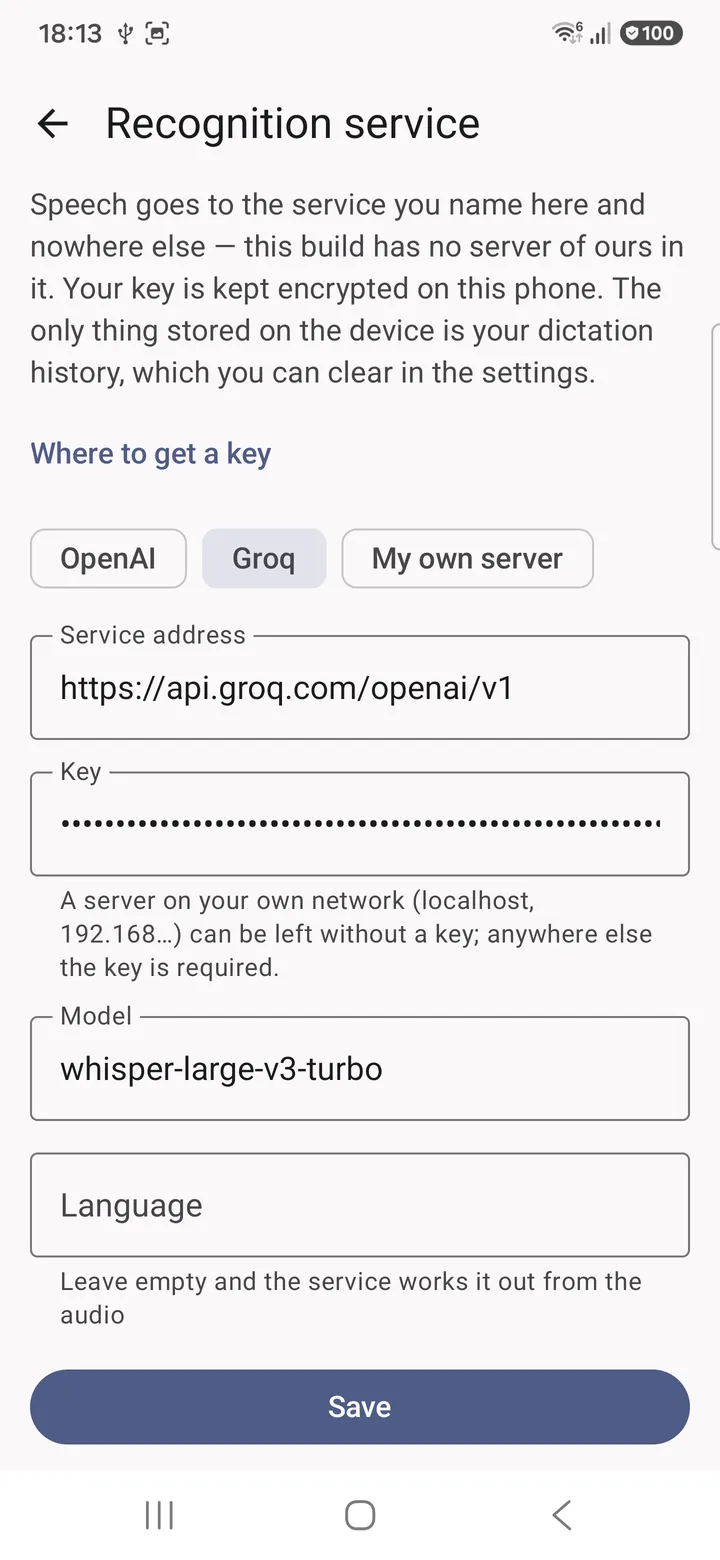
Then press Save and Test connection. "The connection works" means you are done. "The key was not accepted" means the key, not the address. "Fill in the address and the key first" means a field is still empty. The full setup, install included, is on the VoiceBoard open build page.
If the service does not answer in your country
Some countries get nothing back from either vendor, whole regions rather than individual accounts, and no amount of key fiddling changes that. Russia is one of them: neither OpenAI nor Groq answers from a Russian address. The keyboard has a Proxy section for exactly this case, with Off, HTTP and SOCKS5 modes and fields for Proxy address, Port, Proxy login (if required) and Proxy password (if required). Which proxy goes in there is your decision: we do not recommend providers, and we have tested those settings on a desktop rather than on a phone.
The alternative is to stop crossing the border with your audio at all, which is the next section.
The third route: no key at all
A Whisper server running on your own computer speaks the same protocol as the two services above, costs nothing per hour, and accepts an empty key because the keyboard allows that for addresses on your own network. It is slower than Groq, it needs the computer to be awake, and it takes an evening to set up. Our guide walks the whole chain, docker command to phone: local Whisper server, three ways.
Frequently asked questions
Is the Whisper API free?
OpenAI's is not: the account is prepaid, and whisper-1 costs $0.006 a minute. Groq's has a genuinely free tier, which on 10 September 2026 allowed 20 requests a minute, 2,000 a day and 28,800 seconds of audio a day, which is eight hours of speech. For dictation from a phone that is closer to unlimited than to a trial.
Can I get a surprise bill?
Not in the usual sense. OpenAI takes the money in advance, so the balance you topped up is the ceiling. Groq's free tier is bounded by rate limits rather than by a bill: past the limit the requests stop until the window resets, and the paid tier is something you move to on purpose. The way to spend real money here is to point a script at the key, not to dictate messages.
Which model should I choose?
Start with whisper-large-v3-turbo on Groq: cheapest and fastest, and Groq puts its word error rate at 12% against 10.3% for the larger model. Move to whisper-large-v3 if names and terms come back wrong often enough to annoy you, and note that turbo transcribes only, so translation into English needs the larger model.
How long does getting a key take?
About five minutes on either service, and most of it is the sign-up. The difference is what happens after: a Groq key starts working immediately, an OpenAI key starts working once there is credit on the account.
Do I need a key for a local Whisper server?
No. VoiceBoard allows an empty key for addresses on your own network, which covers localhost, names ending in .local, and the 10.*, 172.16-31.* and 192.168.* ranges. Anywhere else a key is required, and plain http is refused.
Key in hand?
The keyboard is two screens away: install the APK, open Recognition service, paste the key, press Test connection.
Set up VoiceBoard